
Labradorite: what kind of stone is it and why does it shimmer
In short: Labradorite is a feldspar that "plays" due to labradorescence: light reflects between microscopic layers of the mineral. The most common color is blue-green, while spectrolite from Finland produces a full spectrum. With a hardness of 6-6.5 on the Mohs scale, the stone is suitable for necklaces, earrings, and pendants, but not for rings that may strike surfaces.
The first time you see labradorite, you might think someone lit the stone from below, or that its surface is coated with something. But no. This effect happens internally and cannot be artificially replicated.
What is labradorescence
Labradorite is a feldspar with microscopic layers of two mineral phases. These alternate with a thickness of tens of nanometers. When light passes through these layers, it reflects and refracts between them, like in a soap bubble or an oil slick on water.
Different layers produce different colors depending on the viewing angle. This is why the stone "plays" when tilted. This effect is called labradorescence – named after the mineral itself.
Colors
The most common color is blue-green. However, golden, orange, and, less frequently, a full rainbow spectrum can be found. What gives the full spectrum of colors is called spectrolite – a variety of labradorite from Finnish deposits.
The color depends on the thickness of the layers and the angle of incidence of light. Two stones from the same deposit will be different. This is not a defect – it is a property of the mineral.
Where it is mined
The name comes from the Canadian island of Labrador, where it was discovered in the 18th century. But today, the main deposits are in Madagascar, Finland, Norway, Russia, Mexico, and Ukraine. Madagascan labradorite typically yields rich blue and turquoise. Finnish spectrolite offers the fullest spectrum of colors.
Hardness and wear
Hardness is 6-6.5 on the Mohs scale. Less than quartz, so it can be scratched by sand and household dust with prolonged wear. Not suitable for rings that constantly bump against surfaces. Fine for necklaces, earrings, and pendants.
Store separately. Silver or metal jewelry nearby will leave scratches.
Labradorite in SIERRA jewelry
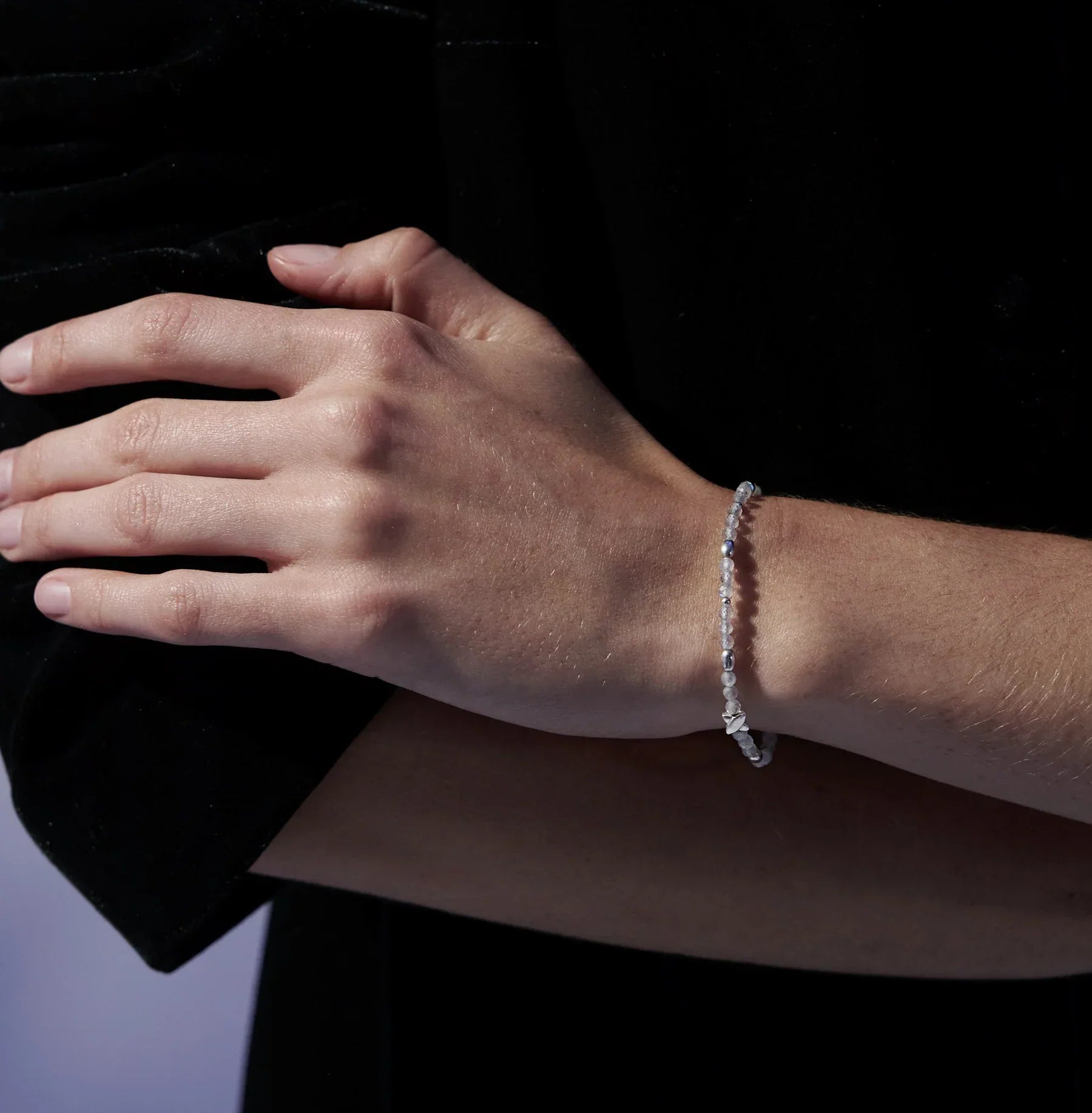
In the "STAR TIDE" bracelet
, labradorite with blue iridescence is used. Each stone looks different – a different pattern, a different play angle. No two are alike.
Care
Soft cloth, no chemicals. Ultrasonic cleaning is best avoided – due to its thin layering, the mineral may react to vibration. Warm water with neutral soap and a soft brush is fine.
Frequently Asked Questions
Are labradorite and moonstone different things?
Yes. Both are feldspars and both have optical effects. But moonstone exhibits adularescence – a milky-white or bluish sheen, not a full-color play. Labradorite exhibits a more active and sharper play of colors.
Why doesn't some labradorite display play of color?
The effect is present only in certain cuts of the stone. If cut incorrectly or if the deposit yields stones with very thin layers, the play is minimal. A skilled cutter orients the stone to maximize labradorescence.
Can I buy synthetic labradorite?
Synthetic labradorite with the same effect does not exist. There are glass and coatings that imitate the play of colors, but not from within the stone. It's not difficult to distinguish – in real stones, the effect is deep and changes smoothly from different angles.
Read also: Aquamarine, Labradorite, Garnet, Selenite: meanings of stones · Aquamarine: what kind of stone it is and why it is chosen for silver jewelry · Conscious choice of jewelry: why we choose natural
More on the topic – in the Moon Muse collection.