

Baroque, River, and Sea Pearls: What's the Difference and Which to Choose
Briefly: Marine pearls (Akoya, South Sea) are the most expensive, round, and have a bright luster. River pearls are cultivated in rivers and ponds; they are cheaper and more diverse in shape. Baroque pearls are irregularly shaped, each unique. A natural pearl can be identified by its grittiness when rubbed against a tooth and its coolness to the touch, unlike smooth plastic.
Pearls are the only jewelry material of biological origin. They form when a mollusk isolates an irritant with a layer of nacre. Hence the unpredictability of their shape—especially in baroque pearls.
| Pearl Type | Where Cultivated | Shape | Luster and Price |
|---|---|---|---|
| Marine (Akoya, South Sea) | Japan, Australia | perfectly round, from 10 mm | bright luster, most expensive |
| River (Freshwater) | China, Japan | rice or irregular | softer luster, lower price |
| Baroque | marine or river | irregular, each unique | valued for character |
| Rice | subspecies of river pearls | elongated, 2-4 mm | delicate mother-of-pearl effect |
Marine Pearls
Mainly cultivated in Japan and Australia. The most famous are Akoya (small, perfectly round, bright luster) and South Sea (large, from 10 mm, duller luster). This is the most expensive type.
Round marine pearls with strong luster are what most people imagine when they hear the word "pearl."
River Pearls (Freshwater)
Cultivated in rivers and ponds, mainly in China and Japan. Their shape is rarely perfectly round—more often rice-shaped or irregular. The luster is softer than marine pearls. However, the price is significantly lower, and the variety of shapes is greater.
Most jewelry in the mid-price segment with pearls is river pearls.
Baroque Pearls
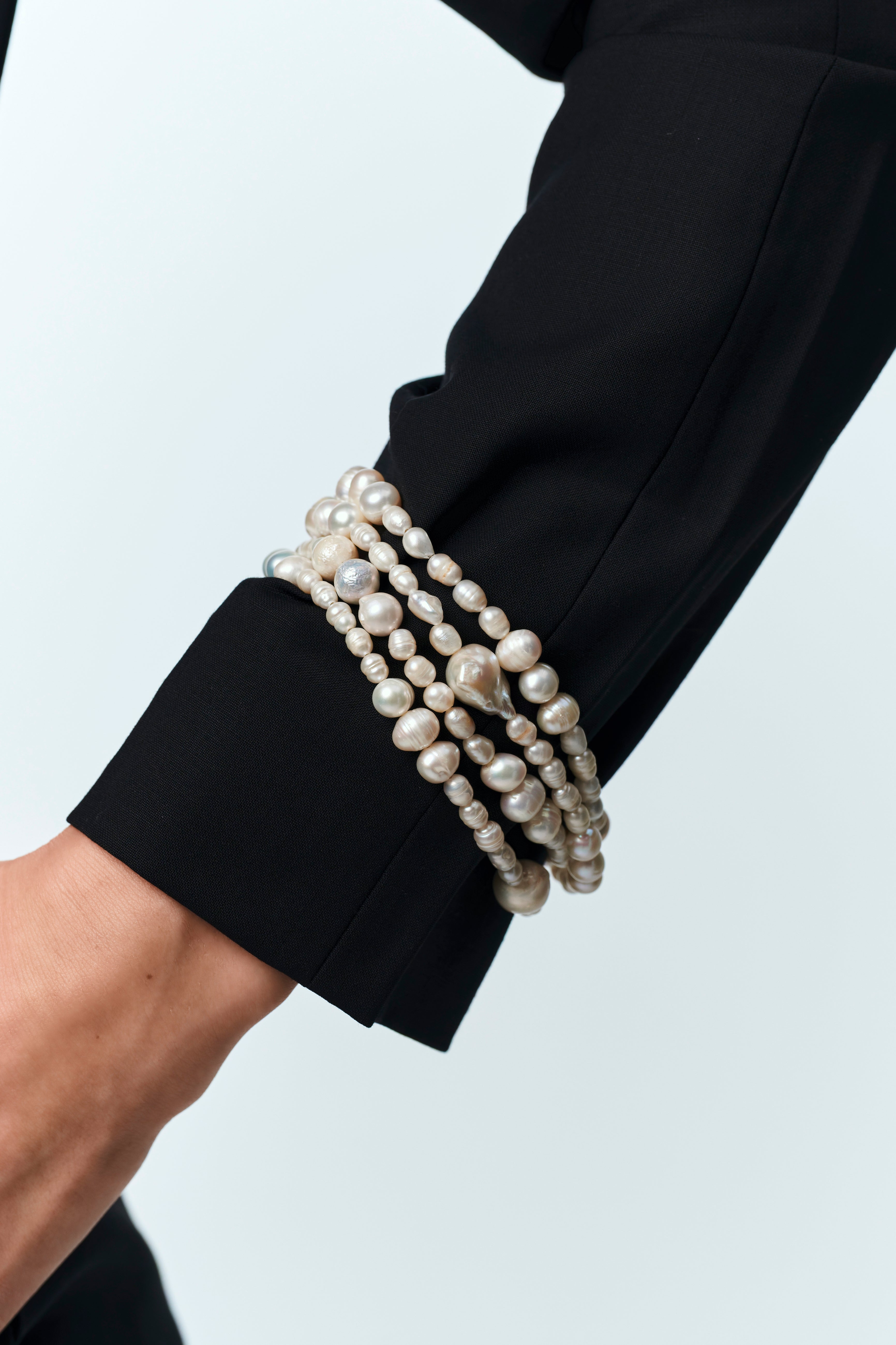
This is not a separate species—it's a name for irregularly shaped pearls. They can be either marine or river pearls. Their main characteristic is that no two are alike. Each pearl is unique in shape.
In jewelry aesthetics, baroque pearls are valued for their character. A piece of jewelry with baroque pearls is always one-of-a-kind, even if made from the same batch of material. In SIERRA SPACE, baroque pearls are used in the Ocean Muse collection—the Pearl Eclipse necklace, bracelets, and earrings.
Rice Pearls
A subspecies of river pearls—small, elongated, from 2 to 4 mm. They are strung on a thread or silver wire tightly together. They give a delicate mother-of-pearl effect without a heavy look. In SIERRA SPACE, such pearls are used in the AQUA MUSE collection—1.8-2 mm pearls from Korea.
How to Distinguish a Natural Pearl from Plastic
Rub the pearl against your tooth. A natural pearl will feel sandy, with a slight grittiness—this is the microstructure of the nacre. Plastic or glass will be smooth.
Temperature: A natural pearl is cool to the touch and slowly warms up from body heat. Plastic heats up quickly.
Frequently Asked Questions
Will pearls from different batches be the same color?
No. Even from the same batch, pearls differ in shade and luster. If a perfect pair is needed, the master selects them by hand.
How long do pearls live in jewelry?
Decades with proper storage. Pearls are sensitive to perfumes, hairspray, and prolonged contact with water. Dry storage and wiping after wear are the main rules.
Are dark pearls dyed?
Not always. There are naturally dark pearls—Tahitian black pearls. But some dark river pearls are indeed dyed. Ask the seller or look at the color uniformity: dyed pearls often look too homogeneous.
Read also: Pearl jewelry 2026—why it's relevant again · Aquamarine, labradorite, garnet, selenite: meanings of stones · Conscious jewelry choice: why we choose natural


%20are%20the%20most%20expensive,%20round,%20and%20have%20a%20bright%20luster.%20River%20pearls%20are%20cultivated%20in%20rivers%20and%20ponds;%20they%20are%20cheaper%20and%20more%20diverse%20in%20shape.%20Baroq...)